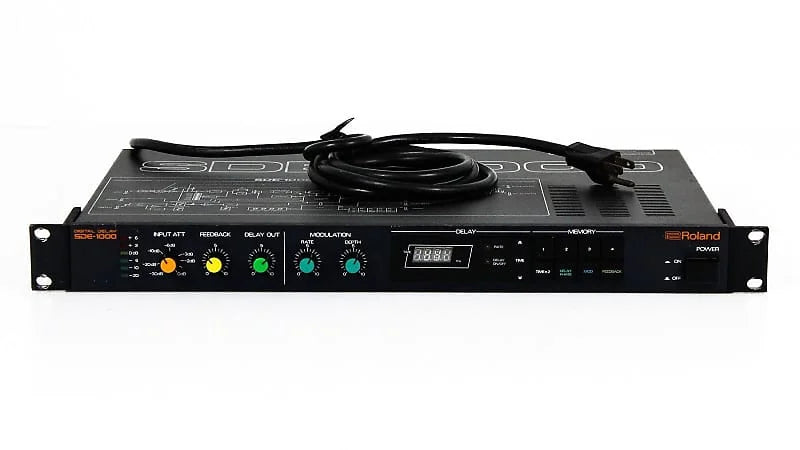
USED: Roland SDE-1000, digital delay
USED: Roland SDE-1000, digital delay
Stock status ✅ in stock in store - ready for pickup / shipping
Lagerstatus er vejledende. Kontakt os gerne inden dit besøg i butik / før dit online køb - så laver vi et lagertjek hurtigt muligt. Klik her
Couldn't load pickup availability
Used: Roland SDE-1000, digital delay. From the 1980s.
Super good condition, almost like new. (The pictures do not show the actual item we have in the store)
Translated text, may contain errors
The Roland SDE-1000 was one of the Japanese company's first effects units - a digital delay line. Roland DDLs became quite common in London studios in the 1980s and were some of the first Japanese-made effects to be found in studios.
The SDE delays were fast and easy to use with a very straightforward front panel and interface. If you look at modern products from the likes of Korg and Yamaha, you'll see clear influences from the SDE-1000 and SDE-2000
Despite being early, groundbreaking devices, these Roland delay lines were fantastic devices and proved to be extremely reliable. The sound quality was excellent with a smooth, very analog sound. The maximum delay time is 374mS in standard mode (747mS in x2 mode) and 605 / 1210mS using the x1.5 control on the rear panel. The sound of the SDE in X2 mode is quite reminiscent of a slow tape delay, and increasing feedback results in a gradually decaying, dull repetition – again like tape. It sounds good
A common feature of early digital delays was the ability to double the delay time (and halve the bandwidth) by changing the clocking. The SDE-1000 goes one better with a hidden delay time control on the rear panel, which is variable from x1 to x1.5.
Delay time is displayed on a 4-digit blue fluorescent display with an up-down toggle switch to change delay settings. The VCO has speed and depth controls. This can provide deep chorusing effects or a gently changing delay with phase division. Unlike the SDE-2000, it has 1000 memories to store user presets
The SDE-1000 looks more generically Roland than the SDE-2000. This is partly due to the adoption of the usual Roland control knobs – also found on late SDE-2000s – and partly due to the large number of 1U units coming onto the market. It’s hard to make 1U units distinctive, but Roland has achieved it with the SDE series. The front panel is a masterpiece of industrial design, crafted with Germanic simplicity, with clear white markings on a black front panel
Share